If you’re a student in Nigeria, you already know that pocket money is not always enough. Lectures, assignments, and a social life don’t leave much room for a 9-to-5, but bills don’t care about your timetable.
That’s one reason students are turning to freelancing.
It gives you the flexibility to work when you have time, build skills that employers value, and earn from clients both in Nigeria and abroad. According to Payoneer’s Freelancer Insights Report, global demand for freelance work remained highly resilient, with 46% of freelancers reporting an increase.
The best part is that many freelance careers don’t require years of experience to get started. With a laptop, a reliable internet connection, and a commitment to learning, you can start earning income while you’re still in school.
Here are ten of the best freelance jobs for students in Nigeria.
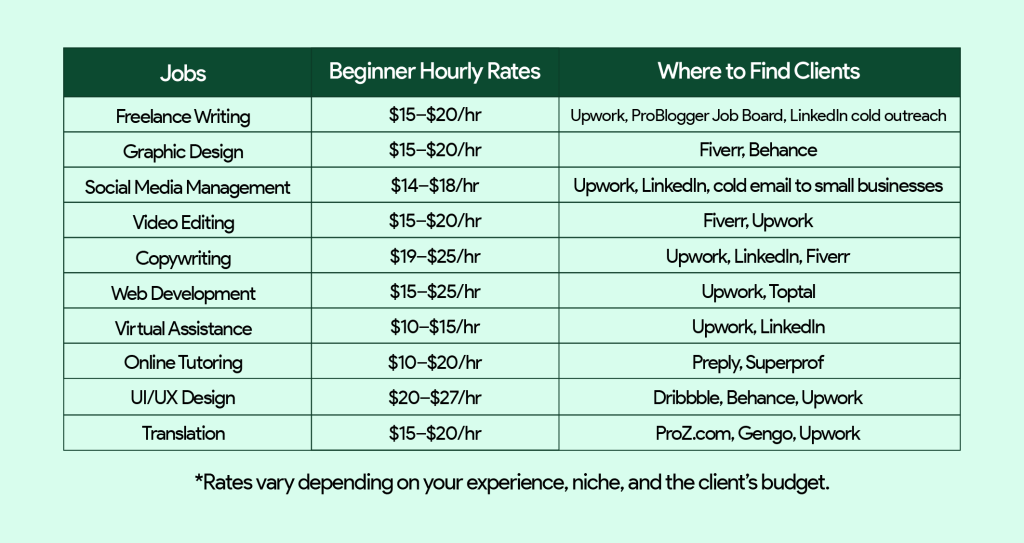
1. Freelance writing
Strong writing is one of the easiest skills to turn into income. Every day, businesses publish blog posts, newsletters, case studies, website pages, and email campaigns to attract customers.
The barrier to entry is relatively low compared to many other freelance careers, and you don’t need a degree in journalism or English to get started. Clear communication, curiosity, and the ability to explain ideas are often more valuable than formal qualifications. As you gain experience, you can specialize in industries like technology, finance, healthcare, or SaaS, where writers typically earn more.
Typical earnings: Beginners often charge between $20 and $150 per article, while experienced writers can earn several hundred dollars for long-form content.
Where to find clients: Upwork, ProBlogger, LinkedIn, and direct outreach to startups.
2. Graphic Design
Every business needs visuals: social media graphics, brand logos, pitch deck designs, product packaging. If you have an eye for design or are willing to learn tools like Canva, Adobe Illustrator, or Figma, there’s consistent demand for this skill.
Many beginners start by learning Canva or Figma before moving on to Adobe Photoshop or Illustrator as their skills improve. The key is building a portfolio that demonstrates your style and ability to solve design problems.
Typical earnings: $20–$80 per project for beginners. Experienced designers working with international brands earn significantly more.
Where to find clients: Fiverr, Upwork, Behance.
3. Social media management
Many businesses understand the importance of social media, but keeping up with content creation, scheduling posts, and responding to comments takes time. That’s why startups, small businesses, and personal brands regularly hire freelance social media managers.
As a social media manager, you create content calendars, write captions, design graphics, schedule posts, and track performance. Many small businesses and startups will pay a monthly retainer fee to have someone handle this reliably.
Typical earnings: $100–$500 per month per client, depending on the scope of work.
Where to find clients: LinkedIn, Upwork.
4. Video editing
Short-form video has become one of the biggest marketing channels for businesses and creators. YouTube, TikTok, Instagram Reels, and LinkedIn videos all require editing before they’re ready to publish, and many creators would rather outsource that work than spend hours behind editing software.
Learning tools like CapCut, Adobe Premiere Pro, or DaVinci Resolve can open the door to freelance opportunities across different industries.
Typical earnings: $20–$100 per video for beginners, with experienced editors charging considerably more.
Where to find clients: Upwork, Fiverr, and LinkedIn.
5. Copywriting
While freelance writing focuses on educating or informing readers, copywriting is all about persuasion. Copywriters create landing pages, sales emails, product descriptions, advertisements, and website copy that encourage people to take action.
Businesses are often willing to invest more in copywriting because strong copy can directly increase sales and conversions.
Typical earnings: Between $50 and $500 per project, with experienced copywriters charging much more for sales pages and email campaigns.
Where to find clients: LinkedIn, Upwork, and Contra.

The Beyond Borders: Nigerian Global Earners Survey 2026 aims to uncover how Nigerians are earning from clients around the world. If you’re a freelancer, your experience can help paint a more accurate picture of the industry’s growth.
6. Web Development
If you can build websites, you’ll never struggle to find freelance work. Every business wants a website, and some of them need theirs redesigned, fixed, or updated. Web development takes time to learn properly, but the return on that time investment is among the highest of any skill on this list.
Typical earnings: $200–$2,000+ per project depending on complexity.
Where to find clients: Upwork, Toptal, LinkedIn.
7. Virtual Assistance
Virtual assistants handle tasks that business owners don’t have time for, like inbox management, scheduling, research, data entry, customer support, and travel booking. It’s one of the easiest ways to start freelancing with minimal technical skills.
The pay isn’t the highest, but it’s consistent, and it often leads to longer-term working relationships.
Typical earnings: $5–$20 per hour, or $200–$600 per month for part-time retainers.
Where to find clients: Upwork, OnlineJobs.ph, LinkedIn.
8. Online tutoring
Doing well in a subject can become a valuable source of income.
Online tutoring allows you to teach students in Nigeria or abroad through video calls, interactive whiteboards, and learning platforms. Subjects like mathematics, English, chemistry, physics, economics, and programming are consistently in demand.
One of the biggest advantages is flexibility. Since lessons are scheduled in advance, you can choose teaching hours that fit around lectures and exams. Many tutors also enjoy the satisfaction of helping students improve academically while earning extra income.
Typical earnings: $10–$50 per hour depending on the subject and platform.
Where to find clients: Preply, Superprof.
9. UI/UX design
Every app and website you use has been designed by someone. UI (User Interface) designers focus on how digital products look, while UX (User Experience) designers make sure they’re easy to navigate and enjoyable to use. Together, these skills are in high demand as more companies build digital products.
Learning tools like Figma is a great place to start, and there are plenty of free tutorials available online to help you build your skills.
Typical earnings: $30–$100 per hour.
Where to find clients: Dribbble, Behance, Upwork.
10. Translation
Being fluent in more than one language can open the door to freelance work that many students overlook. Companies regularly hire translators to adapt websites, user guides, subtitles, legal documents, and marketing materials for different audiences.
Typical earnings: $0.05–$0.20 per word, depending on the language pair and level of expertise.
Where to find clients: ProZ.com, Upwork, Gengo.
How to get paid as a student freelancer in Nigeria
Landing clients is only half the job. The other half is getting paid, especially if you’re working with international clients.
Many clients outside Nigeria prefer to pay freelancers in dollars or even cryptocurrencies. While that’s convenient for them, it can be confusing if you’re new to crypto or don’t want the hassle of manually converting your earnings before spending them.
Crane makes that process much simpler. Instead of worrying about wallets, exchanges, or bank transfers, you can choose the payment option that works best for you.
In general, Crane offers three ways for freelancers to receive crypto payments from international clients.
1. Bank Direct: Receive crypto directly into your bank account
Bank Direct is the easiest option if you’d rather receive your earnings in naira without dealing with crypto yourself.
Once you’ve set up Bank Direct in the Crane app, your client simply sends USDT (or another supported cryptocurrency) to your Crane wallet address. Crane automatically converts the payment to naira at the current exchange rate and sends it straight to your Nigerian bank account, often within minutes.
It’s ideal for freelancers who want fast access to their earnings without going through the extra step of converting crypto manually.
2. Regular Crypto Deposit: Keep your earnings in crypto
If you’d rather hold your earnings in crypto, you can choose Regular Crypto Deposit instead.
Your client’s payment is deposited into your secure Crane wallet, where you can keep it for as long as you like before converting or withdrawing it.
To help you get more value from your earnings, Crane also offers Auto-Convert. This feature allows you to set a target exchange rate for your crypto. For example, if you receive your payment when 1 USDT equals ₦1,300, but you’d rather convert it when the rate reaches ₦1,500, Auto-Convert will automatically complete the conversion once that rate is reached. You don’t have to keep checking the market yourself.
3. Payroll Request: Get paid on time
Working with long-term clients often means getting paid on a fixed schedule. Payroll Request helps make that process smoother.
Instead of reminding your client every month, you can send a payroll request through the Crane app. The request includes your payment details and acts as a reminder, making it easier for employers to pay you on time. It’s particularly useful if you’re working on a monthly retainer or as a remote contractor for an international company.
With your payment information already included, clients can process your payment more quickly, and you spend less time chasing invoices and following up on overdue payments.