You’re right if you think stablecoins suit everyday transactions because of the word “stable.” Stablecoins are cryptocurrencies tied to another asset class, such as a local currency (fiat) or gold, for price stability.
As a result, businesses, including freelancers and content creators, increasingly use stablecoins like USDT and USDC for cross-border payments and a store of value. The 2023 Coin Metrics data backed this assertion, revealing that on-chain stablecoins settlements exceeded $7 trillion, more than popular fiat card payment companies like Mastercard and American Express.
Stablecoin transactions typically happen through USDT or USDC, as they have the largest market share. Both coins have unique strengths and weaknesses. In this piece, we’ll explain the factors to consider before using USDT or USDC for payment settlement.
Here are the key points to note:
1. USDT and USDC are stablecoins made for cross-border payments.
2. Network type, reserve backing, and fees are factors you should consider before choosing the stablecoin (USDT or USDC) you should use to receive payments from international clients.
3. Crane is built for receiving (NOT sending) stablecoins like USDC and USDT in Nigeria. You can also use it to convert crypto to naira.
USDT vs USDC: A comparison table
The comparison table summarises the similarities and differences between USDT and USDC.
| Features | USDT | USDC |
| Currency peg/asset | US dollar | US dollar |
| Ethereum Virtual Machine (EVM) compatibility | Doesn’t support EVM networks. | Supports both EVM and non-EVM networks. |
| Transaction speed | It’s generally swift because the network (non-EVM) it uses processes transactions fast. | Varies depending on network congestion. |
| Transaction fees | Generally low, depending on the network. | It varies depending on network congestion. |
| Reserve backing | A single entity (Tether Limited) controls the financial reserve. | Financial institutions control the reserve. |
| Decentralised finance (DeFi) integration | It’s limited. It requires wrapped tokens. | It natively connects with DeFi. |
| Market cap as of June 2024 | It has the biggest market share with over $112 billion. | It’s worth over $30 billion and has the second-highest share in the stablecoin industry. |
| Network support | It operates on its blockchain or blockchains with virtual machines different from EVMs. Examples include Tron (TRC-20), Binance Smart Chain (BEP 20), Solana, etc | Supports non-EVM and EVM networks like Ethereum, Flow, NEAR, Polygon, etc |
USDT vs USDC comparison tableUSDT: The dollar-collateralised stablecoin

USDT, or Tether, is a fiat-backed coin. It’s pegged directly at a 1:1 ratio to the US dollar.
Tether Limited controls USDT reserves in US dollars (or the traditional currency equivalent), cash equivalents, and other assets, including receivables from loans made by Tether to third parties. Besides US dollars, Tether supports euros (EURT) Mexican peso (MXNT), offshore Chinese yuan (CHNT), and Gold (XAUNT).
USDT was originally launched in 2014 on the Omni Layer protocol (now discontinued). USDT now supports other network protocols, such as:
- Algorand
- Celo
- Cosmos
- EOS
- Liquid Network
- Solana
- Tezos
- Tron
- Ton
How to buy Tether (USDT)
You can buy USDT by depositing US dollars with Tether-authorised platforms. Likewise, you can redeem USDT tokens for US dollars at a 1:1 ratio.
You can use USDT like other currencies or tokens on the chain it supports. Besides, the USDT value is equal and interchangeable in every chain it supports. That is 1 TETHER token on Blockchain X = 1 TETHER token on Blockchain Y.
USDC: The digital dollar

Like USDT, the USD Coin (USDC) is a fiat-backed cryptocurrency. Its value is pegged directly to the US dollar.
Circle manages USDC reserves using the Circle Reserve Fund (USDXX), a Security Exchange Commission (SEC) registered money market fund. The Cash Reserve Fund contains cash, short-dated US Treasuries and overnight US Treasury repurchase agreements with leading banks. The fund reserve suggests that financial institutions regulate USDC business, unlike USDT which belongs to a single entity.
USDC supports 16 blockchain networks, including:
- Algorand
- Arbitrum
- Avalanche
- Base
- Celo
- Ethereum
- Flow
- Hedera
- NEAR
- Noble
- OP
- Magnet
- Polkadot
- Polygon
- PoS
- Solana
- Stellar
- zkSync
Like USDT, users can buy USDC from cryptocurrency exchanges, including Binance, Yellow Card, and Bitnob in Nigeria.
USDT vs USDC: which stablecoin should you use for cross-border payments?

USDT and USDC are stablecoins built for cross-border transactions. Their prices are pegged to real-world currencies (e.g., the US dollar and euro) to offset the conventional cryptocurrency instability. They are easy to buy—you can purchase stablecoins with local currencies. All the aforementioned make USDC and USDT suitable for international payment settlements.
However, consider the factors listed below to decide which stablecoin you should use for international payment transactions.
1. Reserve backing and transparency
Stablecoin value and operations depend on the reserve of the currency or commodity it’s pegged to. USDT and USDC are tied to currencies, such as the US dollar, euros, and the Australian dollar. As a result, reserves influence stablecoin availability and, by extension, circulation in the market.
Reserves are dynamic; they’re updated monthly because they change daily. USDT has over $100 billion in circulation and over $6 billion in equity as of June 25, 2024. Similarly, USDC has $32.6 billion in circulation and over $ 32.7 billion in reserves.
As the reserve and circulation figures show, USDC is behind USDT. However, financial institutions manage USDC reserves, giving it an edge in operation regulation, market transparency, and coin stability compared to USDT.
2. Network type
The network facilitating transactions on the blockchain influences transaction speed. For instance, non-Ethereum Virtual Machines (EVM), like Solana, Bitcoin, and TON are generally faster than EVMS, such as Bitcoin and Binance Smart Chain (BSC), as shown in the table below:
| Non-EVM | Transaction speed (in TPS) | EVM | Transaction speed (in TPS) |
| Solana | 1,504 | Binance Smart Chain (BSC) | 378 |
| Sui | 854 | Polygon | 190 |
| TON | 175 | Ethereum | 23 |
| TRON | 159 | Starknet | 12.3 |
| Near Protocol | 118 | Arbitrum | 59 |
| Aptos | 49 | Linea | 56 |
| Bitcoin | 11 | Base | 37 |
The table indicates that non-EVM networks have the fastest transaction time. Therefore, choose a stablecoin that supports non-EVM protocols if you fancy swift international payments. USDC supports non-EVM and EVM protocols, while USDT supports non-EVM networks primarily.
The blockchain network also affects acceptability. The type of blockchain network (non-EVM or EVM) a cryptocurrency supports dictates its global acceptability, ease of use, and application. In this sense, USDC compatibility with non-EVM and EVM networks gives it a wider application in the cryptocurrency industry, especially in Ethereum-powered decentralised finance (DeFi).
In contrast, USDT doesn’t natively integrate DeFi because it doesn’t support EVM protocols. As a result, you can’t use USDT to execute smart contracts directly. Instead, you must use wrapped tokens (e.g., wUSDT) on the Ethereum blockchain to access smart contract functionalities.
3. Transaction fee
A direct relationship exists between network design and transaction fees on the blockchain. For instance, networks with simple architecture like non-EVMs are built to complete transactions faster, leading to cheaper processing fees. In a nutshell, the underlying network design powering stablecoin operations affects speed and processing fees.
Which crypto platform can receive USDT and USDC in Nigeria?
You need a platform to receive stablecoins. This is where Crane, a blockchain-powered platform in Nigeria for receiving cryptocurrencies in seconds, comes in. The off-ramp service helps businesses and freelancers in Nigeria collect payment in USDT or USDC and convert it to naira.
How to receive USDC and USDT on Crane

Crane provides three ways to receive stablecoins, such as USDT and USDC. The options are:
I. Regular Crypto Deposit: It lets you receive crypto into your digital Crane wallet. It’s your cup of tea if you want to receive and save your earnings in crypto. Regular Crypto Deposit works like this on Crane: receive payments into your digital wallet > convert to naira whenever you want > send the naira to your local account.
Click the button below to learn the step-by-step guide to receiving crypto payments with Regular Crypto Deposit 👇🏾
II. Bank Direct: It allows you to receive crypto directly into your local bank account. It doesn’t require any manual crypto-to-naira conversion—Crane will handle it for you. It works like this: share wallet with business client > receive the naira equivalent of crypto payment directly into your local bank account.
III. Request Payroll: It’s an invoice and payment option service. It lets you send invoices to your clients and get paid in one breath. Less paperwork, more efficiency.
How to convert USDT or USDC to naira on Crane
You can convert USDT or USDC received via Regular Crypto Deposit or Request Payroll by following the steps listed below:
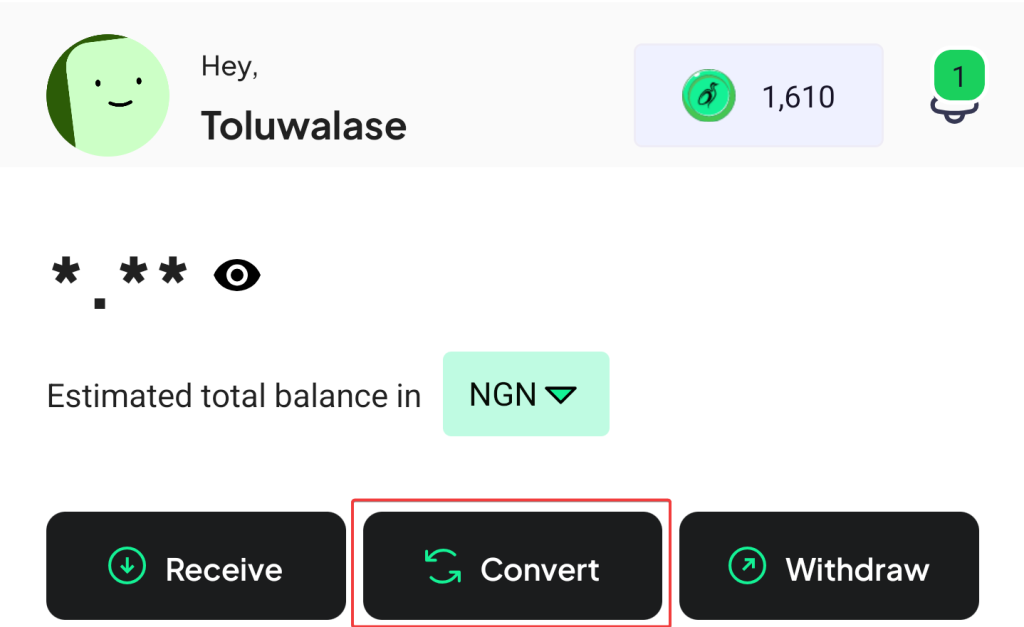
1. Select Convert on the homepage of the Crane app.
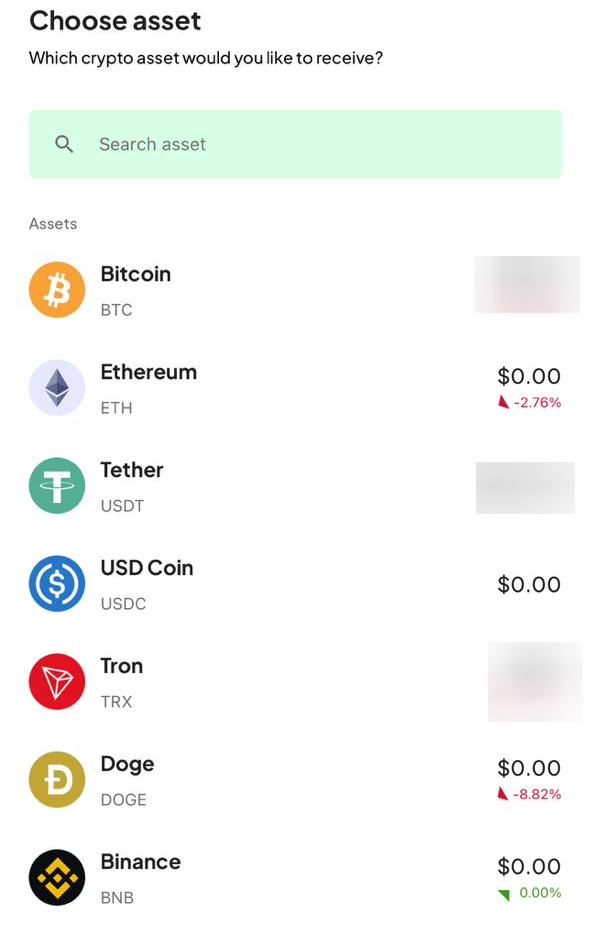
2. Select the digital asset you want to convert. We selected USDT for this guide.
3. Select the USDT value you want to convert to naira.
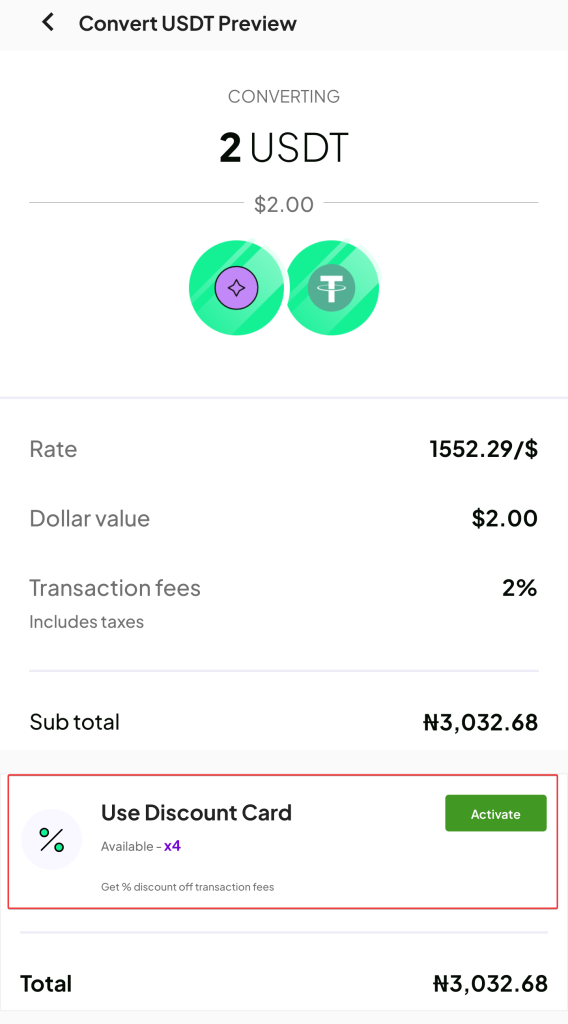
4. Review the conversion value and charges on the preview page. Use the discount card to enjoy a 25%-100% bonus off the conversion fee. The discount card is at the base of the conversion preview page. Then click “confirm” to proceed.
5. Input your transaction PIN and your crypto will be converted to naira instantly. Contact [email protected] if you encounter any crypto-to-naira conversion difficulties.