

If you provide services to clients outside Nigeria, you must have considered Afriex vs. Geegpay. Both are payment apps businesses and creators in Nigeria use to send and receive money from international clients.
Despite providing similar services, Afriex and Geegpay aren’t the same. Therefore, you need to understand their unique offerings before using any (or both) of them.
This piece clarifies your burning questions about both cross-border payment platforms.
Afriex vs Geegpay: Service comparisons at a glance
| Service/features | Afriex | Geegpay |
| Core offering | Provides free foreign bank accounts in British pounds (GBP), euro (EUR), and US dollars (USD) to send and receive money. | Provides virtual GBP, EUR, or USD accounts for international remittance. |
| Target audience | Digital nomads, creators, and small and medium enterprises (SMEs). | Creators, remote workers, and freelancers. |
| Fees | It doesn’t charge fees for receiving money into your foreign bank accounts. Similarly, you won’t pay any charge to convert currencies in your Afriex wallet. | Inward local transfers in Nigeria are free. It typically charges 0.7–0.9% of the transaction volume for inbound transfers involving foreign currencies (£, €, & $). |
| Supported currencies | Can send, receive, and exchange money in 10+ currencies, including GBP, EUR, and USD. | Supports 10+ currencies, including Tanzanian shillings (TZS), Ugandan shillings (UGX), Chinese yuan (CNY), Rwandan Franc (RWF), and CFA Franc. |
| Operating countries | You can open free virtual accounts in euros, US dollars, and British pounds in 10+ countries, including Cameroon, Ghana, Ethiopia, and Nigeria. Your residential country determines the eligibility of currency for the virtual account you can open. | You can withdraw cash from banks and mobile money in 25+ countries, including Nigeria, Ghana, Kenya, the UK, the US, Egypt, China, Rwanda, the Central African Republic, and Tanzania. |
| Card services | Provides physical and virtual cards for business expenses only | Provides a virtual dollar card for business and personal spending |
Geegpay by Raenest: The creators’ cross-border payments platform
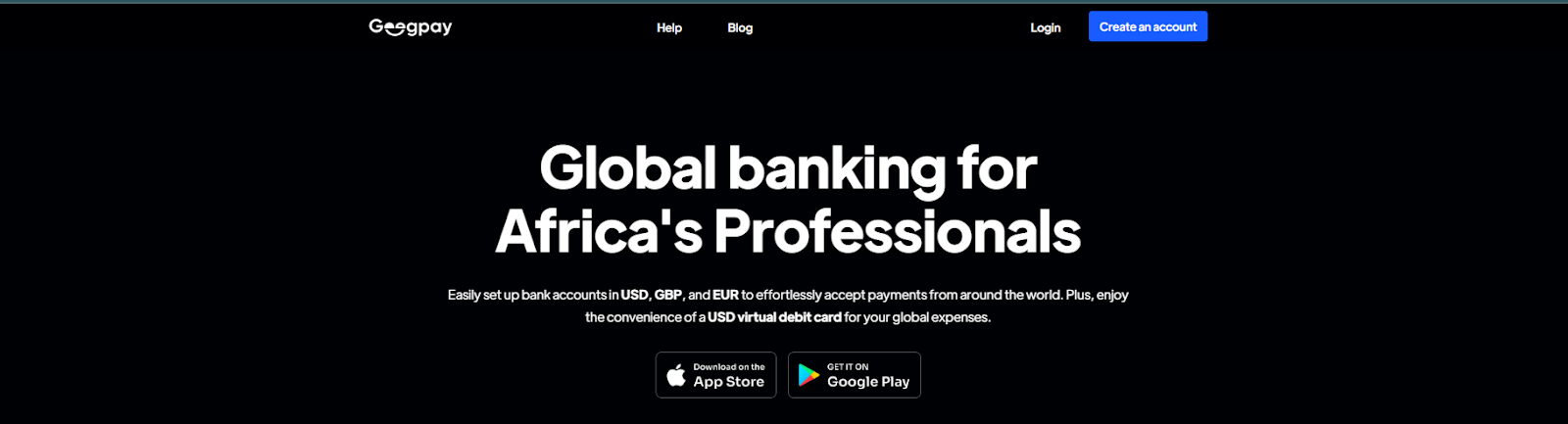
Geegpay, whose parent company is Raenest, makes it easy for freelancers and creators to receive payments. Launched in 2022, Geegpay provides foreign virtual accounts to send and receive money from international clients.
The fintech startup provides a virtual dollar card for cash withdrawals and access to spending activities like online shopping and subscription payment services. You can only use the virtual dollar card to receive payments from US banks or within the US.
Geegpay, as of the time of writing, doesn’t charge card maintenance fees. However, the virtual dollar card service isn’t entirely free. The associated fees for the Geegpay card service are listed in the table below:
| Geegpay virtual USD card service | Cost |
| Creation fee | $3 (one-off payment) |
| Card funding | $0.5 per transaction |
| Transaction charges | $0.5 per transaction |
| Cross-border fee (payments on non-US websites) | 0.9% of the transaction volume (charged by MasterCard) |
The virtual card comes with funding and spending limits:
| Virtual dollar card spending and funding | Limit (in $) |
| Maximum daily funding | 1,000 |
| Minimum funding | 5 |
| Maximum daily spending | 500 |
| Maximum monthly spending | 5,000 |
You don’t need to convert your cash to USD to fund the virtual dollar card on Geegpay. You can add money to your virtual dollar card with any currency (e.g., Naira, EUR, GBP, USD, or local currencies).
Geegpay provides smart invoicing services to auto-bill clients, helping freelancers and businesses collect payments as and when due without doing too much.
How fees work on Geegpay
Geegpay uses a percentage-based system for deposit and transfer charges. The percentage fee depends on the minimum charge, which depends on the currency.
For instance, if you received $1,000 on Geegpay, you’d pay 1% of the transaction ($10) + the minimum charge for USD transactions ($1.50). Therefore, the total fee you’d pay to receive $1,000 on Geegpay is $11.50.
The table below shows deposit fees for supported currencies and countries on Geegpay:
| Currency | Fees | Description | Estimated delivery timeframe |
| EUR | 0.7% with a minimum of €1.5 | It can only be used to receive payments from countries within the European Economic Area (EEA) region. | 1–2 business days |
| GBP | 0.7% with a minimum of £1.5 | It can only be used to receive payments from the UK. | 5 minutes to 1 day |
| NGN | No fee | Only for local transfers in Nigeria | Instant |
| USD (ACH and domestic Wire) | 0.9% with a minimum of $1.5 and capped at $30 | It can only be used to receive payments from the US through ACH or local wire transfer | 1–2 business days, depending on the sender’s payment method |
| USD (SWIFT) | 0.9% with a minimum of $1.50 and a maximum of $30. The amount received depends on the SWIFT fee the sender (SHA, BEN, or OUR) used. | SWIFT | 2–5 business days |
Similarly, here’s a list of the transfer fees for supported currencies and countries on Geegpay:
| Country | Currency | Channel | Fees |
| Central African Republic | CFA | mobile money | 1 USD |
| China | CNY | bank accounts and mobile money | 1 USD |
| Egypt | EGP | bank accounts and mobile money | 2 USD |
| Europe | EUR | bank accounts | 0.35% of the transaction fee, with a minimum of 5 USD and a maximum of 30 USD |
| Ghana | GHS | mobile money | 1 USD |
| Kenya | KES | bank accounts and mobile money | 1 USD |
| Nigeria | NGN | bank accounts | None |
| Tanzania | TZS | bank accounts and mobile money | 1 USD |
| United Kingdom | GBP | bank accounts | 0.35% of the transaction fee, a minimum of 5 USD and a maximum of 30 USD |
| Ugandan | UGX | mobile money | 1 USD |
| United States | USD | ACH | 0.35% of the transaction fee, a minimum of 5 USD and a maximum of 30 USD |
| United States | USD | Swift | 0.35% of the transaction fee, a minimum of 15 USD and a maximum of 50 USD |
| United States | USD | Wire | 0.35% of the transaction fee, a minimum of 10 USD and a maximum of 30 USD |
| Rwanda | RWF | bank accounts and mobile money | 1 USD |
Afriex: The low-cost cross-border payments platform

Afriex is a money transfer app for immigrants, digital nomads, and creators. The platform provides virtual foreign accounts to send and receive money from international clients in Africa and Asia.
The conditions to open a foreign account on Afriex are listed below:
| Region | Type of account you can create |
| The US or Africa (Nigeria, Ghana, Kenya, Egypt, Uganda, Ethiopia, Cameroon, and Ivory Coast) | USD |
| Europe (Belgium, Netherlands, Germany, France, Ireland, and Italy) | EUR |
| United Kingdom | GBP |
As of the time of documentation, receiving money on Afriex is free. You’ll not pay any fees if you send $150 or more. However, if you transfer less than $150 or its equivalent in GBP or EUR, you’ll pay 1 (USD, GBP, EUR) on Afriex.
Summarily, the transfer fees on Afriex are listed below:
| Amount | Fees |
| Receiving money | free |
| Sending money below $150 | free |
| Transfers above $150 | 1 (USD, EUR, OR GBP) |
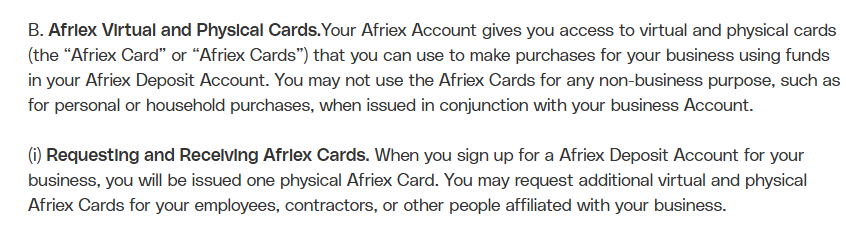
Afriex issues a virtual and physical card known as the Afriex Card for businesses. The physical Afriex Card is automatically issued to users who sign up for the Afriex Deposit Account. You can also request virtual cards for your employees and other people affiliated with your business. Afriex cards can only be used for business purchases, not personal and household expenses.
Additionally, Afriex only supports debit cards for funding and payment withdrawals. It doesn’t accept credit cards, prepaid cards, or PayPal.
Afriex vs Geegpay: which is the best for cross-border payments?
A one-size-fits-all cross-border payment service probably doesn’t exist. Some mobile transfer apps, however, will serve you better than others.
Generally, transaction fees and speed, security, withdrawal options, integration with third-party apps (e.g., Deel, Upwork, Fiverr, and Payoneer), and virtual card spending limits are factors businesses, creators, and freelancers consider before choosing a payment service.
Afriex is for you if:
1. You want a low-cost option to send and receive money
Both cross-border payment services don’t charge you for transactions involving local transfers in Nigeria. Afriex, however, takes the cake here because receiving money in foreign virtual accounts is free too.
Besides, transfer fees are capped at 1 USD (or its equivalent in GBP and EUR) for transactions worth $150 or more. Afriex also offers a no-charge on wire transfers worth $25,000 and above, making it possible for SMEs to pay their vendors abroad.
In contrast, Geegpay charges deposit and transfer fees, depending on the foreign currency.
This distinction is especially for freelancers or creators who just want a platform to receive and send money without spending an arm and a leg on fees.
2. You value security (and you should!)
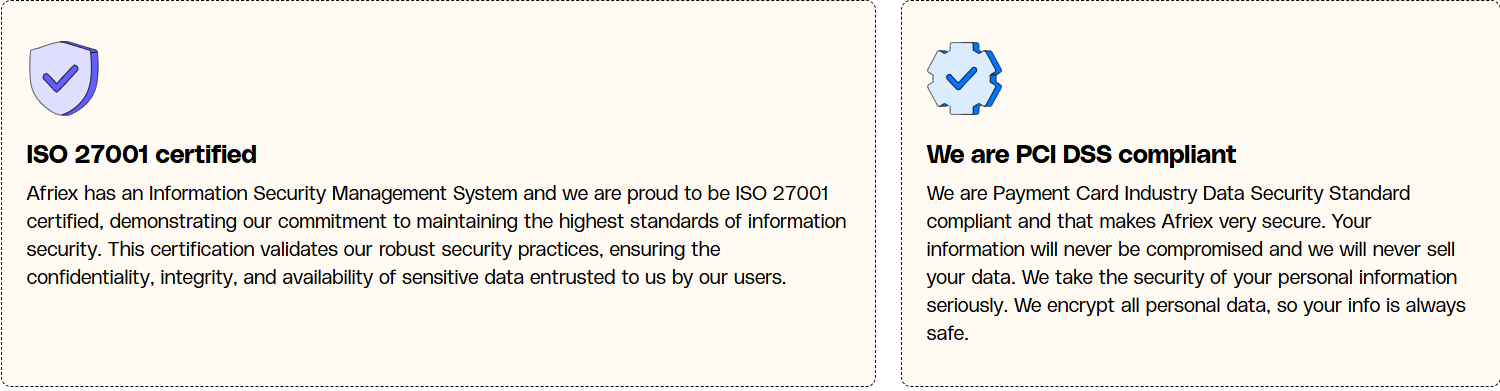
It’s rare to see a payment service that doesn’t claim to be security compliant. But the devil is in the details. Afriex is PCI DSS compliant, as proclaimed on their website. PCI DSS means Payment Card Industry Data Security Standard, which outlines the guidelines financial institutions processing payment cards must implement for secure transactions.
Additionally, Afriex says they’re ISO 27001 certified, which loosely means the mobile transfer app implements the best security practices to safeguard user privacy and respond actively to anomalies swiftly if (or when) they occur.
The jargon about PCI DSS and ISO 27001 may not interest you. But one thing should excite you about this seemingly unnecessary technical information: your personal data and card activities are safe with them because they adhere to these security standards.
3. Your clientele is based in Africa
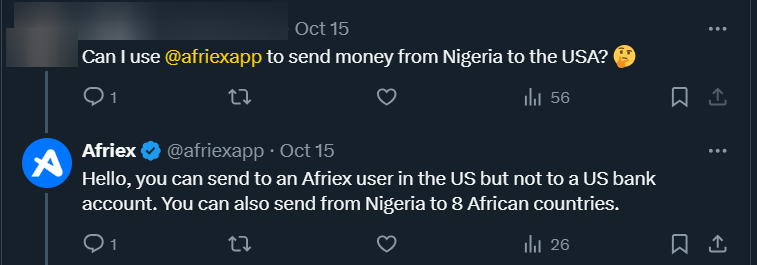
Afriex provides foreign virtual accounts in three dominant currencies (USD, EUR, and GBP). The currencies are available in multiple countries across four broad regions—Africa, the US, and Europe, including the UK. From the list, Africa has the highest representation with eight countries. This suggests that Afriex is heavily focused on the African market, and that’s good news for you if your business partner (s) reside there.
4. You want a high daily spending limit
Afriex’s daily spending limit is $3,000, which is significantly higher than Geegpay’s $500.
On the flip side, consider using Geegpay if:
1. You want smart invoicing
Invoicing matters to creators, freelancers, and businesses. It helps them simplify bill payment collection from clients. Geegpay provides a smart invoicing system that automates the process.
2. Multiple withdrawal channels
Geegpay lets you send money to banks and mobile money in 100+ countries. Besides, you can withdraw and send money to payment platforms like PayPal, Payoneer, Wise, and Revolut.
It also lets you collect payment directly from selected third-party apps, including freelance platforms (e.g., Upwork and Fiverr), people management systems (e.g., Deel), and payment platforms (e.g., Stripe, Payoneer, PayPal, and Brex).
3. You want a versatile virtual card
This is your cup of tea if you fancy online shopping. Geegpay claims their virtual dollar cards are accepted globally, including the Apple Store, Google Play Store, Amazon, Meta, X, iTunes, etc. In contrast, Afriex cards are restricted to business spending only.
Besides, you can add the card to Apple Pay and Google Pay for contactless payments for in-person shops that support it.
Crane: An alternative cross-border payment platform to Afriex and Geegpay

One thing is immediately obvious with Geegpay and Afriex: using their platform costs a few quid. That’s on-brand for traditional financial institutions. But if you want a swift payment processing platform without paying neck-breaking fees, Crane is for you.
Crane is built on blockchain technology, the secure public ledger system that records digital transactions in blocks. No single entity owns the block; therefore, account opening is less prolonged. Besides, the communal principles of blockchain technology make it easy to send and receive money from anyone, anywhere, in a flash.
Because blockchain technology powers Crane, you can use it to receive payments in cryptocurrency and convert them to your local currency.
Benefits of using Crane for cross-border remittance
1. Near-instant automatic crypto-to-naira conversion with Bank Direct
No crypto experience? Not a problem. You can receive crypto money in your local bank with Bank Direct. It automatically converts crypto to naira and sends the converted amounts to your preferred bank account.
2. Affordable transaction fees: Receiving crypto is free
Pay only 2% of the transaction volume to convert from crypto to naira.
3. Access to global business partners, vendors, and clients
Crane removes payment restrictions. This helps you expand your business to clients outside your location and get paid in a heartbeat.
4. Adherence to security and regulatory standards
Crane complies with Know Your Customer (KYC) and anti-money laundering (AML) laws for transparency and accountability. We also provide in-app security like two-factor authentication to prevent unauthorised entries to your account.
5. Easy bill collection with payroll request
We make payment collection as simple as eating pie with the payroll request, which allows you to request bills from your clients.
Crane vs Afriex vs Geegpay: How their services compare
To understand how Crane’s services compare with Afriex and Geegpay, check the table below:
| Service/Feature | Crane | Afriex | Geegpay |
| Transaction fees | No deposit fees. Receiving payments in crypto is free on Crane. You’ll only pay 2% of the transaction to move crypto to your digital wallet. | Receiving money is free but transfers above $150 cost 1USD | Charges for deposit, transfer, and other virtual dollar card-related charges. |
| Transaction speed | Near instant, depending on the cryptocurrency. | Transactions usually take multiple business days to complete. It depends on the currency involved. | Usually several business days. Processing time depends on the currency, location, and transaction type. |
| Acceptance level | Can receive payments in crypto from anywhere. Currently, you can only convert crypto to naira in Nigeria. | Supports payment transfers and withdrawals in 10+ countries, including the USA, UK, Nigeria, Ghana, and Pakistan. | Operates in 20+ countries, including European countries, the United States, and the Central African Republic |
| Currency support | Naira and seven other virtual currencies (BNB, BTC, DOGE, ETH, USDC, USDT, and TRON). | Supports 10+ currencies, including £, €, and $. | Supports 12 currencies. |
| Card services | ❌ | Provides physical and virtual cards for businesses. Supports only debit cards for funding and payment withdrawals. | Provides a virtual dollar card for cash withdrawals, online shopping, and subscription payment services. |
| Invoicing | Provides payroll requests for bill collection from international clients | Not available | Provides smart invoicing |
| Integration with freelance platforms | You can receive payment from clients on any freelance platform using crypto. | The virtual accounts can receive money from Fiverr, Deel, Upwork, etc. | Its USD account works on freelancing platforms that accept USD bank accounts. |


