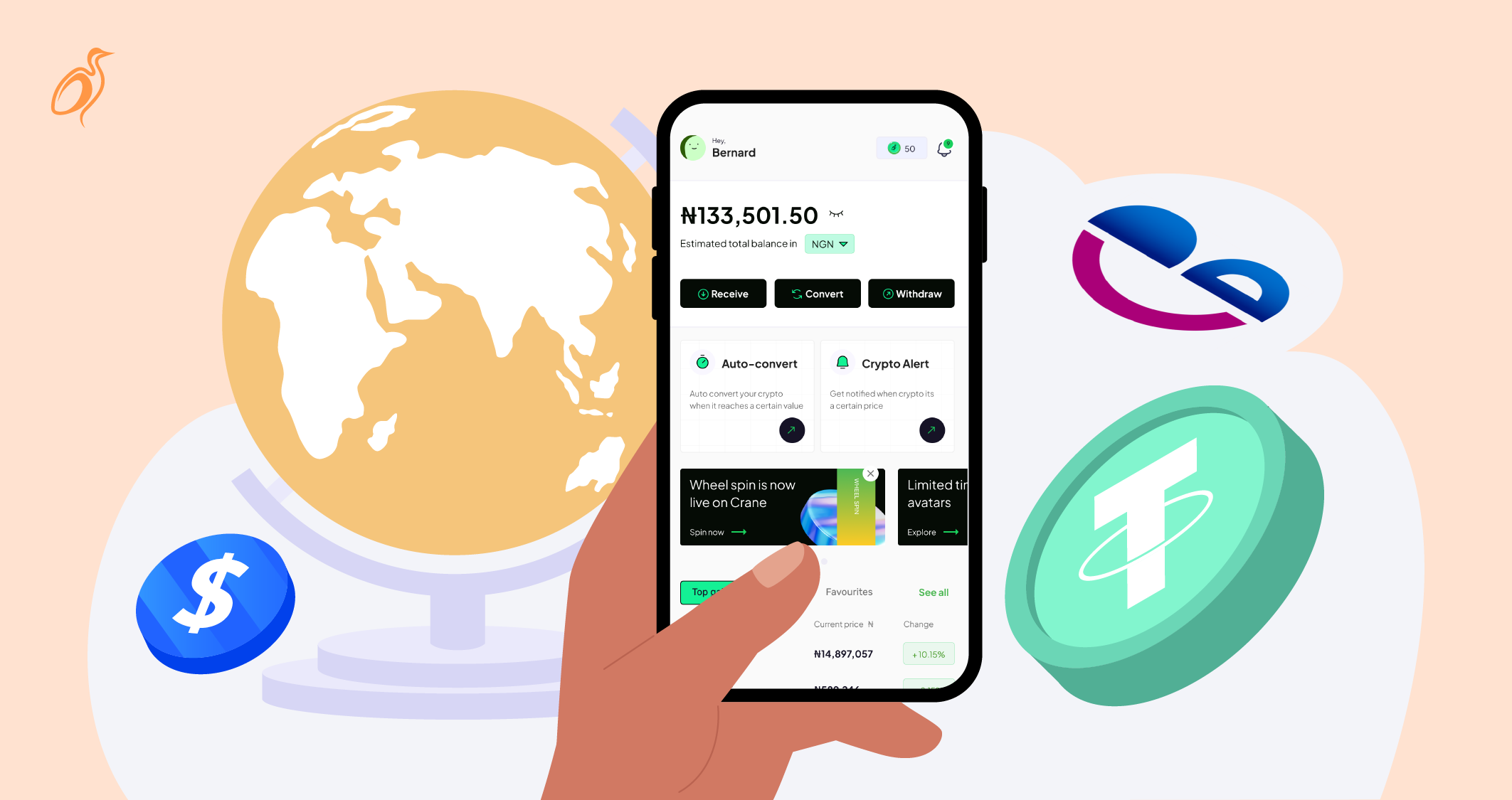
“On-ramp” and “off-ramp” are terms you must have seen on popular crypto platforms, especially if you receive payments in digital currencies. But just like many terms in the crypto industry, you may not understand what crypto ramps mean. This piece, however, will explain everything you need to know about ramping in crypto.
Summary table: How crypto on- and off-ramp services compare
The table below highlights the functionalities of crypto ramps.
| Metrics | On-ramp | Off-ramp |
| Functionality | Use local currencies (e.g., naira) to buy cryptocurrencies (e.g., BTC). An example is buying BTC with naira on a crypto exchange platform. | Converting digital currencies (e.g., USDT) to local currencies on a platform like Crane. |
| Subject to the financial regulations of the land. | Subject to the financial regulations of the land. | Subject to financial regulations governing crypto activities. |
| Know Your Customer (KYC) | Required during the onboarding process, especially in countries like Nigeria. | Required during the onboarding process, especially in countries like Nigeria. |
| in-app security measures like multi-factor authentication (MFA) | Variable. It depends on the platform. | It depends on the platform. |
| Examples | Quidax, Yellow Card. | Crane |
Crypto ramping: The link between digital money and local currencies
In construction, ramps are short bridges that make commutes easier. In the crypto industry, ramps have a similar application: they connect traditional finance institutions and decentralised finance (aka DeFi).
In layman’s terms, ramps enable you to buy digital currencies with local currency and vice versa. Without ramps, you would be unable to transfer cryptocurrencies to local bank accounts or buy virtual currencies with local currencies. Ramps, however, removed that barrier, simplifying access to digital currencies for payments, stores of value, and investments.
On-ramp crypto: Buying digital currencies with local currencies

Crypto on-ramps mean buying digital currencies (e.g., BTC, USDC, USDT, etc.) with local currencies like naira and dollars. On-ramp platforms typically let you buy crypto with regular payment systems like bank transfers, credit or debit cards, and ATM cards.
Generally, on-ramp services require you to sign up for their services, complete identity verification, and fund your digital wallet before you can buy cryptocurrencies.
Popular examples of on-ramp services in Nigeria include Yellow Card, MoonPay, and Quidax.
Off-ramping: Converting crypto to local currencies

Off-ramps are the opposite of on-ramps. They let you turn digital currencies into local currencies. Off-ramps provide a digital wallet to receive and store crypto, conversion options to turn crypto into local currencies, and bank withdrawal options.
Like its counterpart, off-ramp platforms require account creation, Know Your Customer (KYC), and generating a wallet address to receive cryptocurrencies. A typical example is Crane, an off-ramp service for receiving crypto payments from international clients in Nigeria. Other examples include Pandar, Busha, and Breet.
Which crypto off-ramp platform is best for receiving payments in Nigeria?

You already worked hard to convince foreign clients or business partners to work with you. Receiving your due pay shouldn’t be an issue. This is where Crane comes in. We’re an off-ramp platform for accepting payments in crypto in Nigeria.
How to receive payments in crypto fon Crane

Crane provides three ways to receive payments from international clients. They include:
1. Regular Crypto Deposit
It’s for receiving crypto into a digital wallet. It’s best for users who prefer to store crypto after receiving it. You can set up Auto-Convert to automatically convert crypto to naira once it reaches a predefined rate.
Auto-Convert works like this: send crypto wallet to clients > receive payments in crypto > convert crypto to naira > withdraw the naira to local bank account.
2. Bank Direct
It lets you receive crypto directly into your local account. After activating the service on the Crane app, we’ll automatically convert payments received in crypto to naira and send them to your designated bank account. Generally, Bank Direct works like this: send wallet to your clients > receive the naira equivalent of the crypto payment in a local bank account within two minutes.
Bank Direct is built for crypto newbies and users who don’t want to interact with the crypto market. It’s swift and convenient.
3. Request Payroll
It’s Crane’s payroll service that can help you request to be paid for products and services. Your wallet will be attached to your invoice, which will help you get paid after the client receives the invoice via email.
Benefits of on- and off-ramp crypto
Now that you know how crypto ramping works, let’s show you its benefits.
1. Easy access to digital currencies
One of the valid criticisms of cryptocurrency acceptance was its relative unavailability compared to local currencies.
Crypto ramps, however, broke the scarcity barrier and increased digital currency adoption, especially in developing countries like Nigeria. This explains why 9 in 10 Nigerians are interested in cryptocurrency in 2023.
2. Access to borderless payments
International payment is a nightmare for many freelancers, businesses, and creators in developing countries like Nigeria. In 2023, the cost of sending money to Nigeria and other Sub-Saharan African countries from the diaspora increased for the 15th consecutive year, with senders paying up to $72 as transaction fees for every $200 sent from abroad.
High processing fees aside, international payments involving traditional banks typically take days to settle. Unexpectedly, payment delays negatively affect business revenue and cash flow, as PwC revealed in 2020.

Digital currencies fix these barriers because they’re built on the blockchain—a decentralised system that eliminates intermediaries like banks and external regulators. The implication of the decentralised system is swift transaction processing, affordable fees, and ease of cross-border transactions.
Check the table below to see how a typical off-ramp service like Crane compares with the average bank regarding ease of cross-border payments.
| Metric | Crane | Traditional finance |
| Deposit fee | Free | Typically charges a percentage of the transaction volume. |
| Processing time | Near Instant | Takes days or weeks. |
| Transaction limits | Every Crane user can receive an unlimited amount of crypto. | It varies and depends on the account type and transaction history. |
3. Improves investment options
The average crypto user in Nigeria invests in virtual currencies to hedge against hyperinflation. While digital currencies are prone to volatility, experts believe investments in stablecoins like USDT and USDC are safe investment options.
A fitting case study is the radical cryptocurrency adoption in Argentina. After the Argentinian peso fell 51.6% around July 2023, the crypto transaction volume in Argentina hit $85.4 billion—the highest in Latin America in 2023.
Martel Steward, the Head of Compliance & AML at Argentina-based Lemon Cash, attributed the high crypto transaction volume to the currency devaluation. “We have really high inflation, and there are [a] lot of restrictions against buying foreign currencies. That makes crypto a valuable option for saving,” Martel explained.
Nigeria, like Argentina, has devaluation issues, with the naira depreciating by 40.6% at the end of 2024. Therefore, on-and-off-ramp platforms provide the channels to own, transact, and invest in cryptocurrencies—especially stablecoins—to fight inflation.
A quick look at Bitcoin’s performance against traditional investment options, such as gold and Nasdaq stock, further buttresses why investment in digital currencies is rarely a bad choice. Between 2009, when Bitcoin launched, and 2023, Bitcoin had a 64.5% internal rate return (IRR). In comparison, gold had a 7.1% IRR, while the Nasdaq IRR was 17.5% within the same 10-year period.

Bitcoin isn’t without risks. it’s a deflationary asset with limited supply. However, its rising demand increases its price, making it a worthy investment against inflation.
FAQs about crypto ramps in Nigeria
1. Are on-ramps and off-ramps the same peer-to-peer (P2P) platforms?
P2P enables direct trading between users. It lets users buy and sell crypto. Similarly, crypto on- and off-ramps are centralised entities for buying and converting crypto to local currency.
While P2P and ramps facilitate cryptocurrency trading and availability. However, they’re not entirely the same, although they’re similar. The controlling body and security levels are the defining differences between them.
A centralised body manages crypto ramps and is subjected to Know Your Customer (KYC) verifications and anti-money laundering (AML) regulations. P2P, on the other hand, may not be subject to regulatory oversight or a central broker.
The table below summarises the differences between P2P and crypto ramps.
| Metrics | On-ramps | Off-ramps | P2P |
| Functionality | Buy cryptocurrencies with local currencies. | Convert crypto to local currencies | Connect traders to buy and sell cryptocurrency |
| Controlling body | Managed by a centralized body | Managed by a centralized body | The control is decentralised. Traders have direct connections for transactions. |
| Security | Subject to KYC and AML regulations. | Requires KYC and AML laws and data privacy regulations. | May or may not be subject to security checks and data privacy laws. |
2. Is Crane a P2P company?
No, Crane isn’t a P2P platform. We don’t connect you to individual brokers. Instead, Crane is an off-ramp platform for converting cryptocurrency to naira.
3. Are crypto ramps regulated in Nigeria?
Yes, crypto companies in Nigeria are subject to regulatory laws like the Accelerated Regulatory Incubation Programme (ARIP), which was launched in June 2024, to monitor their affairs.
4. Do crypto on-and off-ramps require Know Your Customer (KYC) verification in Nigeria?
Yes, KYC verifications are important aspects of the onboarding process for virtual asset service providers (VASPs), which include crypto ramps. KYC and other AML regulations are vital for compliance and accountability.